The Execution Gap: Why 3PLs Between $5M–$75M Stop Growing
A 3PL’s Journey Into Fulfillment
A deep look at the inflection points where complexity outpaces clarity, drawn from hundreds of operator conversations, consulting engagements and the research behind Execution Under Pressure.
About this paper
A practical roadmap for B2B 3PLs moving into fulfillment, walking the journey from 50 orders a day to 10,000, stage by stage. At each stage: what tends to break, what the operation should look like, and what the technology has to do. Written for the operator who wants a map before taking the next step.
Fulfillment is a great move for a B2B 3PL, and it is also a different sport. Your buildings are an advantage. Your processes are mostly not.
What you’ll learn
- The five volume stages, and the process, physical and technology moves specific to each one
- Real collapse-and-recovery stories from operations Vikrant has worked with
- The technology stack matrix: what’s optional at Stage 1 and mandatory by Stage 4
- Billing, labor, returns and WMS switching: the disciplines that decide margin
- A stage-by-stage readiness checklist to self-assess before the next move
Why This Paper.
“If you run a traditional B2B 3PL, you've likely felt the pull. Your clients are asking about direct-to-consumer. Your sales calls include the word "fulfillment" more than they used to. Your peers at IWLA are adding parcel carriers and buying pick-to-light. The opportunity is real.”
The opportunity is real. So is the part most operators do not hear in those conversations. Fulfillment is a great move for a B2B 3PL, and it is also a different sport. Your buildings are an advantage. Your processes are mostly not. Your technology, in most cases, is not either.
This paper is a practical roadmap. It walks the journey from 50 orders a day to 10,000 a day, stage by stage. At each stage I describe what tends to break, what the operation should look like, and what the technology has to do.
I wrote it for the operator who wants a map before taking the next step. The reader I have in mind has run pallets and cases for years, has earned the right to be confident, and wants to approach fulfillment with eyes open.
A note on the series
I covered the leadership and mindset side of 3PL growth in Execution Under Pressure. This paper is the first in a series on the operational and technical side, written to stand alone and to function together as a complete field guide. The other papers are previewed at the end.
The Shift: Why B2B 3PLs Are Moving Into Fulfillment
Three forces are pushing B2B 3PLs toward fulfillment, and none of them are temporary.
01. Brands Want One Partner.
A consumer brand selling into Target and into Shopify wants the same 3PL to do both. So does a manufacturer that's shipped to distributors for years and is now launching a branded line for ecom. They do not want one warehouse for retail replenishment and a separate operation for DTC. Consolidation is cheaper for them and stickier for you. The 3PL that can run both sides of the house becomes the primary partner.
02. Margin Gravity Has Shifted.
Storage and pallet-in, pallet-out handling are commodity services with commodity margins. A well-run fulfillment operation generates several times more revenue per cubic foot, and the stickiness of integration work raises switching costs. Fulfillment is harder, and that is exactly why the margin is there.
03. E-commerce is Not a Channel Anymore.
Every brand is now an omnichannel brand. A 3PL that cannot ship a parcel to a consumer is a 3PL that cannot fully serve its existing retail clients when those clients add DTC. Fulfillment capability is becoming table stakes for keeping accounts, not just winning new ones.
Why The Move is Hard?
The instinct, understandably, is to treat fulfillment as another workflow under the same roof. It is not.
Every row in table below is a process change, a layout change, a labor change, or a technology change. Usually all four. That is why the move is hard, not because fulfillment is technically complex, but because every assumption from the B2B world has to be re-examined.
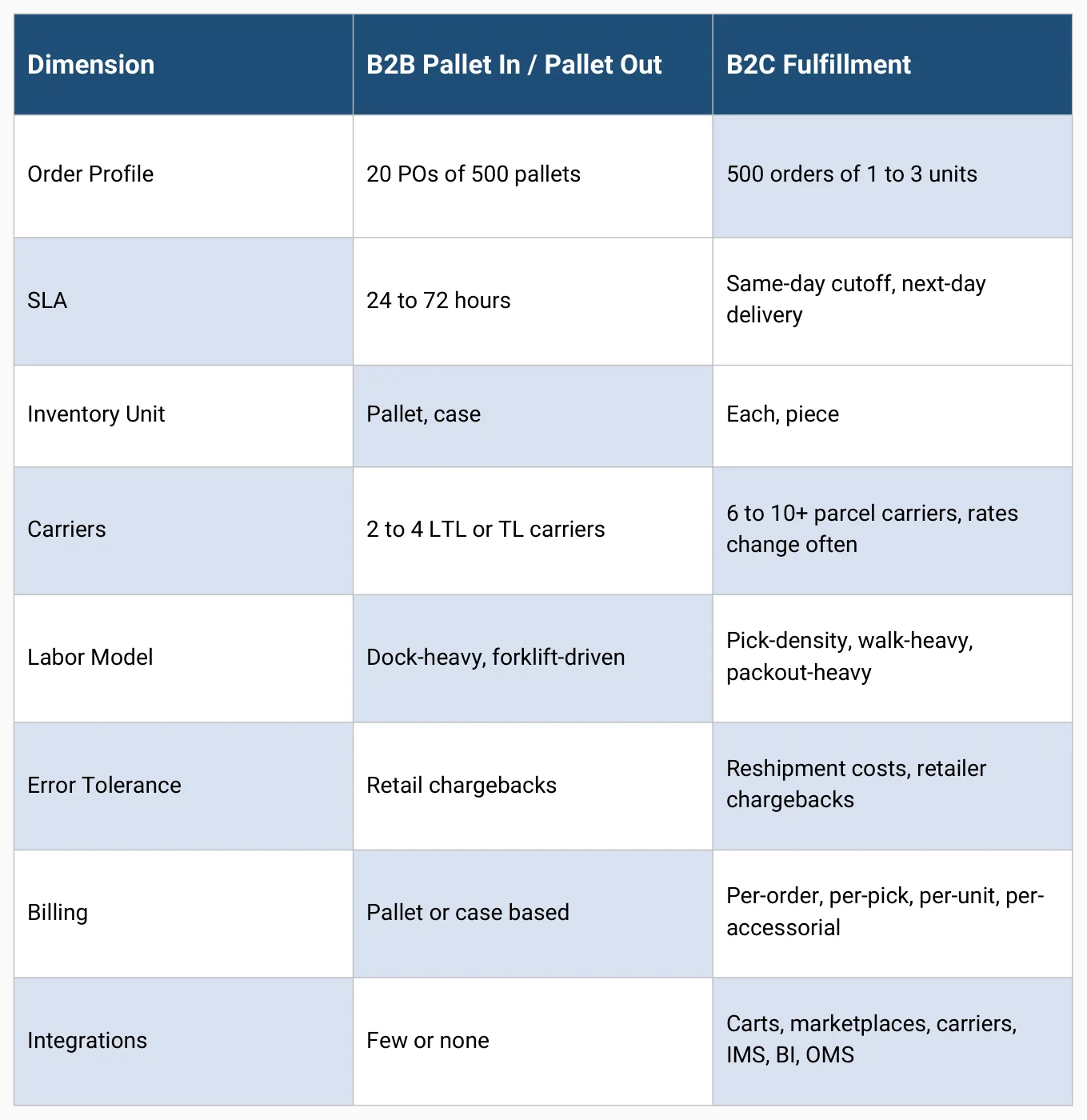
Every row in that table is a process change, a layout change, a labor change, or a technology change. Usually all four.
The move is hard not because fulfillment is technically complex, but because every assumption from the B2B world has to be reexamined.
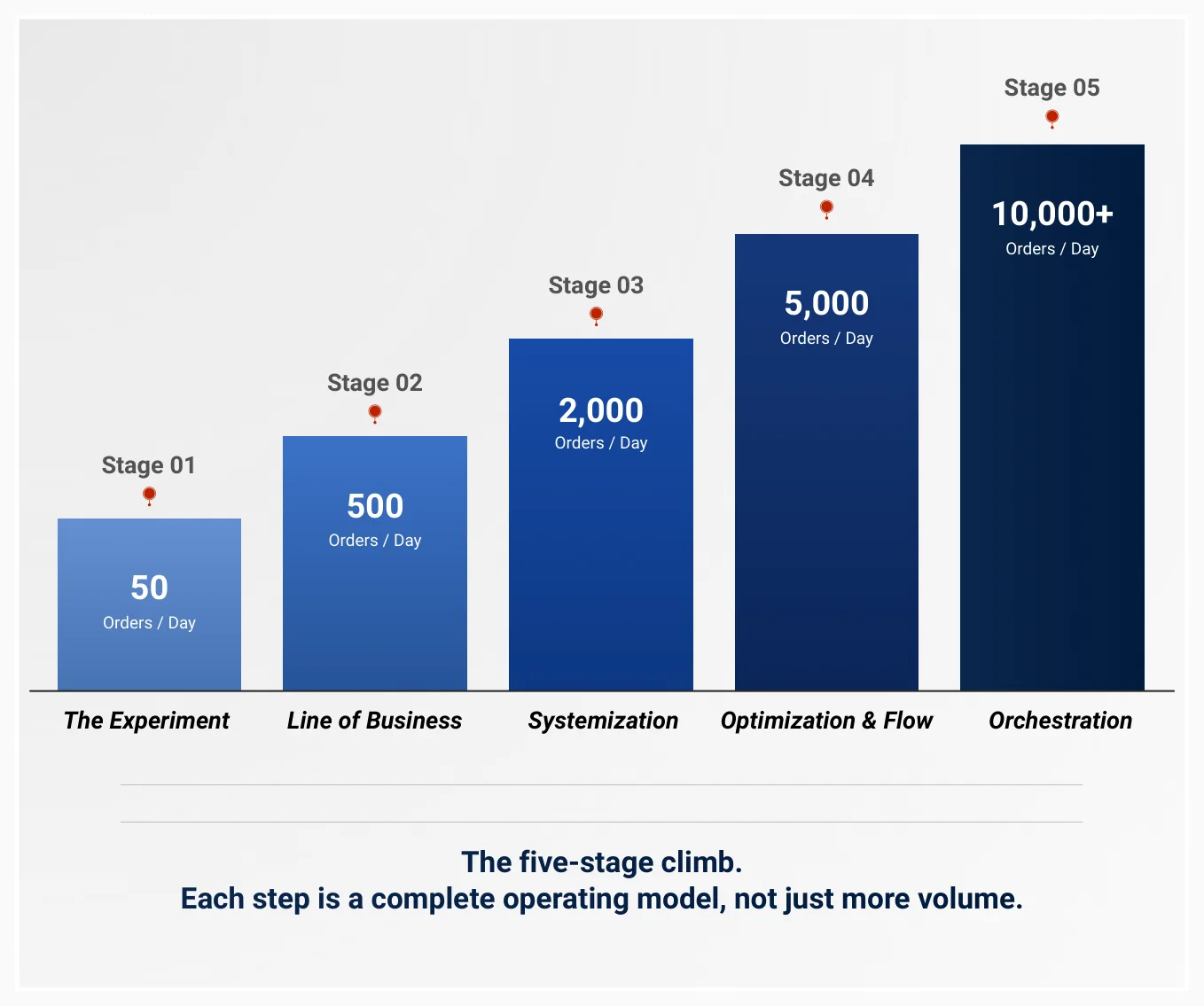
The Journey: Five Stages From 50 to 10,000 Orders a Day
The stages below are not defined by a calendar. Some 3PLs move from Stage 1 to Stage 3 in a year. Others take five. What matters is recognizing which stage you are in, because the process, physical, and technology moves required are specific to that stage. Skipping a stage is how operations break.
Stage 01: 50 Orders a Day (The Experiment)
This is the "let's try it" phase. Usually an existing B2B client has asked whether you can ship their online orders while you store their retail inventory. You agree, set up a corner of the warehouse, and start.
What The Operation Looks Like
Orders arrive through a shared spreadsheet, a client portal, or a basic integration with one shopping cart. A handful of staff pick one order at a time. Inventory lives in the same bulk locations as B2B stock. Labels print one at a time from the carrier site. Packing happens at a folding table.
What Is Acceptable At This Stage
Paper pick tickets, as long as there is some barcode verification at pack. Manual labels. A single carrier. End-of-day reconciliation. None of these are scalable, but at this volume they can work.
What Will Start To Hurt
Mispicks, because without scan-to-validate they are inevitable, and every one hurts the consumer brand. Inventory drift, because orders decrement on paper rather than in the system, and cycle counts catch the gap too late.
Stockouts discovered at pick time rather than at order time.
And almost always, the moment a second client signs up and the corner of the warehouse stops being enough.
A real Stage 1 collapse
One operator I worked with had a building of about 200,000 square feet, mostly pallet-in pallet-out. One of their existing B2B clients started selling on Amazon FBM. A few orders a week at first, then more, then a few dozen a day. Around the same time, a second brand came on doing about 50 orders a day with 70 SKUs.
Still small numbers on paper. But the operation started cracking, and the cracks were not where leadership was looking.
The WMS was B2B. Pallet tags scanned fine. Below the pallet, nothing. So pickers did what pickers do when the system does not help them. They improvised.
Someone would grab a case off a pallet, walk it to a pack station, pull a few pieces, walk the case back. Sometimes to the right spot. Sometimes not. None of it captured. Within a few weeks the system thought inventory was in location A and it was actually sitting open on a shelf in location C. Mis-shipments followed. Then more mis-shipments.
What this stage actually needs
A basic WMS that supports order management and inventory at the piece level, not just pallet or case. Scan-to-validate on picking, even for single-order picks. The habit matters more than the volume. One carrier integration with automated label generation. A real connection to the client’s e-commerce platform that pulls orders and pushes tracking.
Stage 02: 500 Orders a Day (The Line of Business)
Something has worked. Word has traveled. You are onboarding your second, third, and fifth fulfillment client. The operation now has its own rhythm and its own problems.
What The Operation Looks Like
A dedicated pick area, no longer a shared corner. Usually separated from B2B by aisle and process. First forward-pick slots for fast-moving SKUs. Replenishment from reserve is a defined task. Batch picking is introduced. Pickers take 6–10 orders at a time on a cart with tote positions. Dedicated pack stations with label printers, packing slip printers, and scales. Scheduled carrier pickups from two or three parcel carriers. Returns start to arrive and have no clear home yet.
What hurts at this volume
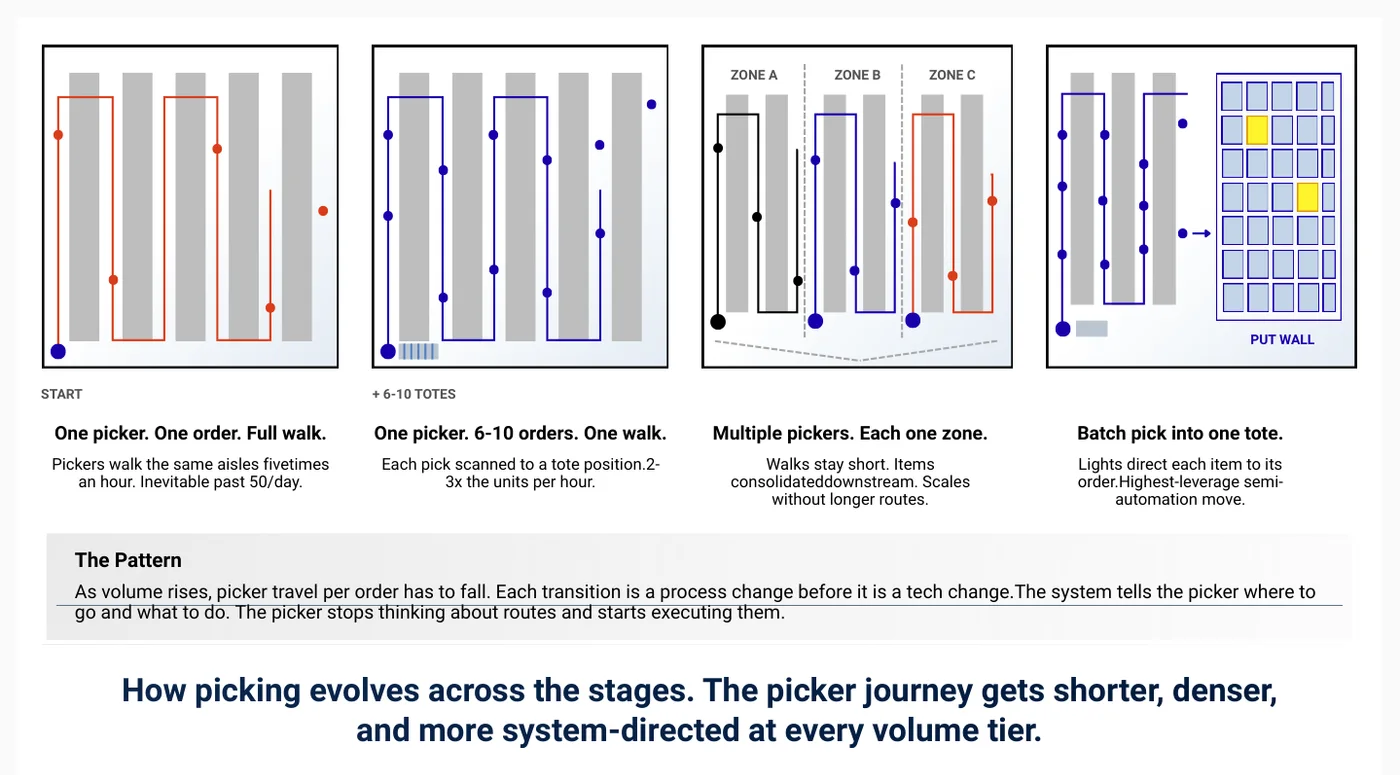
Single-order picking becomes brutally inefficient. Pickers walk the same aisles five times in an hour. Pack stations congest. Labels print to the wrong printer, documents get mixed between orders. Inventory drift without real cycle counting. One off-count creates cascading mispicks. Each new client wants their own shopping cart, their own packing slip, their own inserts. Onboarding takes weeks. Returns pile up because there is no process and no location for them.
Back to that 200,000 square foot operator
By the time their primary client added Shopify on top of Amazon, volume was running 20 to 25 orders a day on that one account, with a second brand layering on. They tried to absorb it with the same people, the same process, and the same WMS. Cost per order quietly went above what they were charging. Leadership told themselves it was an economies-of-scale problem. Get a few more customers and the math will work.
It was not a scale problem. It was a process problem wearing economies of scale as a costume.
The mispicks did not trigger major Amazon performance penalties, but the reshipments piled up. They were buying the product a second time, paying to ship it again, and in some cases paying return shipping to recover the original unit and put it back on the shelf at their own expense. None of that was in the rate card. All of it came out of margin. By the time we crossed paths, leadership was ready to shut the e-commerce side down. The conversation on the table was not how do we scale this. It was how do we kill it cleanly. We did not kill it. We optimized what we could inside the existing WMS, built a wrapper around it for what the WMS could not do, and eventually moved them to a platform built for both sides of the house. They are still operating today, doing both B2B and fulfillment.
The volume that breaks you is smaller than you think, and the WMS that got you here is usually the thing holding you hostage on the way out.
What this stage actually needs
Physical setup
Flow rack or carton flow shelving for top-moving small SKUs. A first designated pack line with a dimensional-weight scale, because dim-weight is the largest hidden cost in early fulfillment. Clear demarcation between B2B and B2C zones. Mixing them is a short-term convenience and a long-term expense.
Technology
A real WMS with batch-picking logic and scan verification on every pick. Pick-to-tote, with inventory decrementing in real time. Rate shopping across three to four carriers. Multi-client architecture, so each brand’s orders, inventory, and reporting stay separate but manageable from one view. API-based integrations to e-commerce platforms. A basic returns process with a scan-based receiving step and client-specific disposition rules.
Stage 03: 2000 Orders a Day (Systemization)
Fulfillment is now a real line of business. You have dedicated supervisors. You may have 8–15 brands on the platform. Clients are asking about peak season planning, SLA dashboards, and cost per order. This is the stage where 3PLs either professionalize or start to lose money.
What The Operation Looks Like
Waves are planned through the day and released against carrier cutoffs, not on an ad-hoc basis. Pick paths are optimized: pickers walk a sequence designed to minimize travel, not just to find the next item. Zone picking is introduced. Pickers specialize in areas and orders are consolidated downstream. A dedicated e-commerce receiving lane handles smaller, more frequent inbounds separately from B2B. Pack stations auto-print labels, packing slips, and inserts based on brand rules. Cycle counting runs on a schedule, and accuracy is a metric reported to clients. SLA dashboards by brand are visible to operations and to the client.
What Breaks At This Volume
Wave planning by spreadsheet or tribal knowledge cannot keep up. Waves miss cutoffs, pack stations starve then flood. Pickers spend 30% or more of their time walking. Units per hour plateau and overtime creeps in. Labor cost per order creeps up without being clearly visible until the monthly P&L lands. Onboarding a new brand takes four to six weeks because every integration is custom. Carrier rate negotiations are on the table but require data you cannot easily produce.
Physical Setup Moves
Expand the forward-pick area with a defined velocity slotting policy (A, B, C) movers mapped to specific zones. Add more flow rack. Top movers should never be stored in a standard shelf bay at this volume. Split pack stations: small parcel versus multi-item or larger cartons. One pack line for everything does not work past 1,500 orders a day. Consider first conveyor: a simple take-away belt from pack to shipping lanes saves 20–30 steps per order.
Technology That Must Scale Now
Wave planning that knows about carrier cutoffs, current labor on the floor, and downstream packout capacity. Pick-path optimization that is carton-aware and zone-aware, not just nearest-next-location. Rate shopping that factors in packaging, zones, client-specific rate cards, and accessorials. Integration architecture that is API-first or EDI-templated, so onboarding takes hours instead of weeks. EDI capability for larger clients, with 940, 945, 856, and 997 flows mapped per retail partner. A billing engine that can invoice accurately per SKU, pick, pallet, storage day, and accessorial against each client’s contract. A client reporting portal.
Stage 04: 5000 Orders a Day (Optimization & Flow)
You are a real fulfillment operation. Twenty to forty brands. A peak season that looks nothing like Q1. Error rate, units per hour, and cost per order are board-level conversations. You are competing for clients against national fulfillment players and winning some of them. This stage is about optimizing every link of the chain.
What The Operation Looks Like
Continuous wave release balanced against carrier cutoffs and available labor. Zone picking with conveyor or cart-based consolidation between zones. Pick-to-tote with scan verification on every line. Totes are routed to the correct pack lane based on order contents. Pack-by-scan: the system identifies the right box size, prints the label and documents, and guides the packer. Slotting reviewed weekly. Fast movers rotate to prime slots based on the last 30 days of velocity.
Returns processed in a dedicated area with brand-specific disposition rules resell, repair, discard. Labor hours tracked against engineered standards per task.
What Breaks At This Volume
Floor congestion. People, totes, carts, and conveyors compete for the same space unless the layout has been re-planned for throughput, not just for storage. Integration debt catches up. Every legacy custom connection is slightly different, and a single cart API change can take a brand offline. Carrier rate files change monthly, and someone missing an update erodes margin silently. Seasonal labor onboarding is a fire drill unless labor standards and pick-direction tools let new hires ramp in days, not weeks.
Physical Setup Moves
A formal forward-pick area with automated replenishment triggers. When a forward slot drops below a threshold, replen is issued from reserve. Pick-to-light in the densest fast-mover zones. For zones with very high SKU count and very high velocity, light-directed picking cuts pick time by 30–50% and error rate dramatically. Put-to-light in batch-pick consolidation. A picker batch-picks 20 orders worth of items into one tote, then places them into a put-wall where lights indicate the correct cubby for each order. Dedicated packout lines per class of order: standard parcel, oversized, fragile, subscription-box.
Technology That Must Now Scale
Fully optimized pick-path logic that considers cubic, weight, pack-station routing, and congestion in real time. Pick-to-tote with consolidation logic that respects order completeness and routes completed orders directly to the correct pack station. Advanced rate shopping: brand-specific carriers, account-level rates, accessorial calculations, dimensional weight factoring, zone-skipping consideration, regional carriers where applicable. Label creation fully automated: compliance labels (for example FNSKU for Amazon), carrier labels, packing slips, and branded inserts, all printed in the right sequence at the right station. Deep EDI and API breadth: five to ten shopping carts, ten or more carriers, marketplace integrations (Amazon MCF, Walmart WFS / DSV where applicable), and BI feeds. Labor management with engineered standards by task, real-time tracking, and dashboards that show variance.
Stage 05: 10,000+ Orders a Day (Orchestration)
You are now in the top tier of independent 3PLs. At this volume, no single process or tool carries the operation. Success is about orchestration, every piece of the floor, every integration, every piece of labor has to be choreographed in real time.
What The Operation Looks Like
Real-time wave orchestration. The system balances inventory availability, carrier cutoffs, labor on the floor, and brand SLAs simultaneously. Multi-modal picking. Batch, cluster, and zone strategies are applied per wave based on the order profile of that wave. Put walls, or in some cases automated sortation, for multi-line orders. Continuous slotting adjustment based on the last seven and thirty days of velocity. Predictive labor planning tied to inbound wave forecasts. Staffing is scheduled against expected order volume, not last week's reality. A full BI suite: cost per order, cost per pick, units per hour per zone, perfect order rate, cost per carton, carrier mix analysis. Returns automation with scan-to-disposition, photo capture, and brand-specific logic.
What Still Breaks If Technology Lags
A single cart API deprecation can take a brand offline for days if the integration was custom. Carrier rate or surcharge changes not reflected in the rate-shop engine silently erode margin every shipment. Onboarding a new brand still takes weeks instead of days, which caps growth even when sales is landing accounts. A single hardware failure: a pick-to-light controller, a conveyor section, a printer drops wave throughput unless the system can re-route in real time.
Physical setup moves
Pick-to-light zones covering the top ten percent of SKUs by velocity. Put-to-light walls for multi-order consolidation after batch pick: the single most effective manual-to-semi-automated transition at this volume. Dedicated replenishment team running forklift replen from reserve into flow rack on a continuous schedule. Manifest-aware pack zones. Each pack station knows which carrier is next, which box sizes to pull, and which documents to print. A dedicated returns center with a scan-based workflow and photo disposition.
Technology That Must Scale Now
A multi-tenant WMS purpose-built for fulfillment scale. A B2B WMS with a fulfillment module stapled on will not survive this volume. Open API architecture for fast onboarding. "We will build you a custom connector" is not a scalable answer; pre-built integrations and standardized EDI maps are. An EDI library pre-built for retail compliance (Amazon Vendor / Seller, Walmart, Target) major grocery and specialty retailers. Rate shopping that is live, not nightly. Every shipment evaluated against current rates, with dim-weight, accessorials, SurePost/SmartPost logic, and zone skips considered. Wave planning that optimizes for labor and cutoffs jointly, not sequentially. Full pick-path optimization aware of put-walls, pick-to-light zones, put-to-light zones, travel time, and congestion. A deep client portal and API. Brands at this scale want programmatic access to their own data. Hardware-agnostic integrations with material-handling equipment, conveyor, sorters, scale-in-motion, and cubing systems.
Operational Infrastructure: A Closer Look
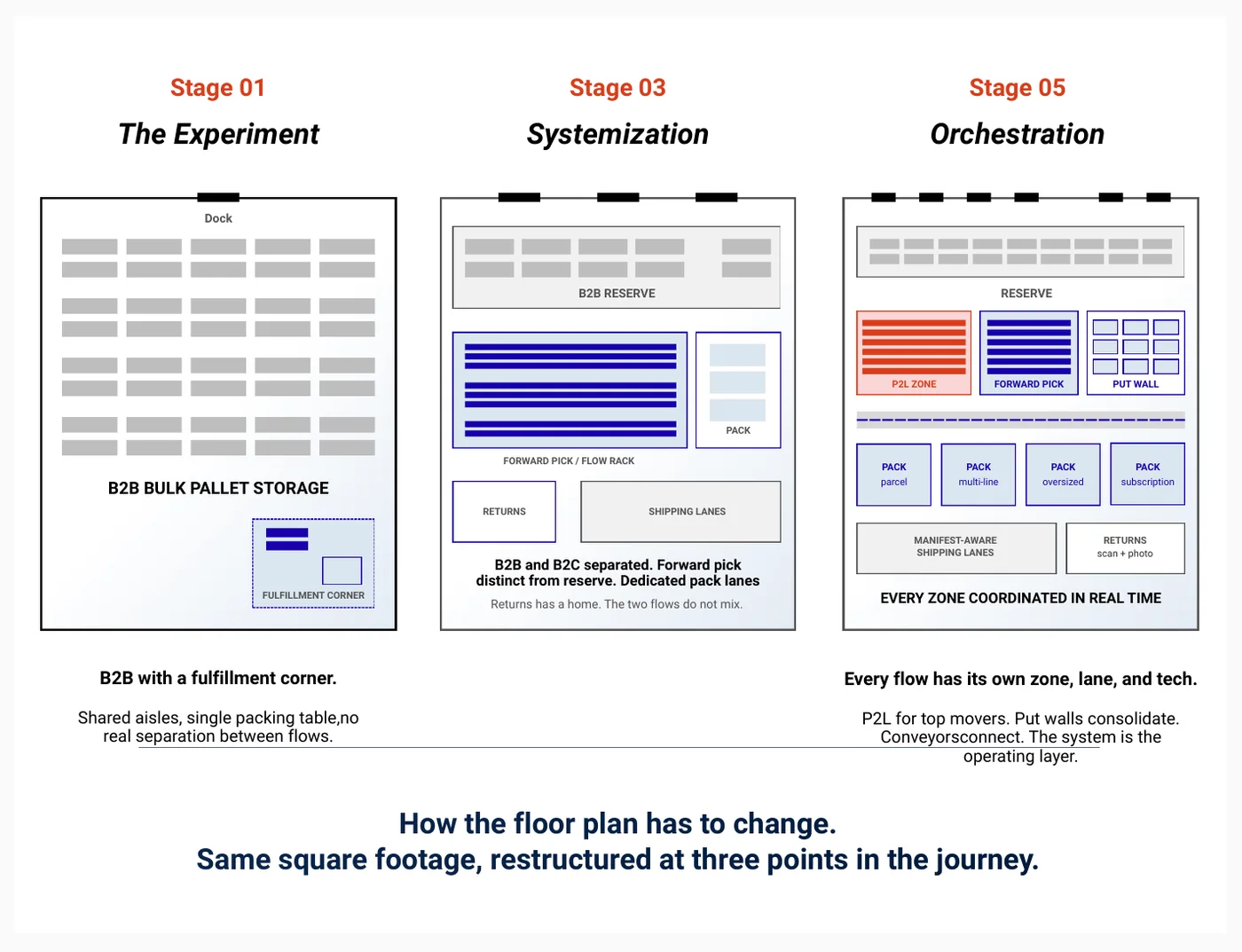
A few elements of physical setup come up at every client conversation and deserve more than a line in a table. The right combination is what separates a Stage 3 operation from a Stage 5 one.
Flow Rack and Carton Flow
Flow rack uses gravity-fed lanes that let product slide to the pick face as the front carton empties. It is the cheapest infrastructure upgrade in fulfillment. Compresses the pick face, keeps fast movers dense, reduces walk. For SKUs that move more than a few times a day, flow rack is almost always the right answer over standard shelving. The common mistake is slotting flow rack by what feels fast rather than by velocity data. Every 3PL at Stage 3 or above should be re-slotting at least monthly.
Forward Pick Areas and Reserve
A well-designed fulfillment operation separates forward pick (the dense, walkable area where pickers actually work) from reserve (where bulk inventory sits). Forward holds a day or two of velocity per SKU. Reserve holds the rest and replenishes forward on trigger. Pickers should not walk into a bulk aisle. Forklifts should not drive into a pick aisle. The two flows do not mix without losing safety and productivity. 3PLs moving from B2B often skip this step because the B2B floor allowed free mixing. Fulfillment does not.
Pick-to-Light
Pick-to-light uses lights and digit displays at each pick slot. The picker scans a tote or order, lights illuminate at the slots where picks are required, and the picker confirms each pick with a button press. P2L works well in dense, high-velocity zones with small SKUs and many picks per hour per picker. It pays back through labor productivity (often a 30 to 50 percent reduction in pick time) and through error rate, which drops dramatically. For operations above 3,000 orders a day with concentrated velocity, the case usually closes in 12 to 18 months.
Put-to-light and put walls
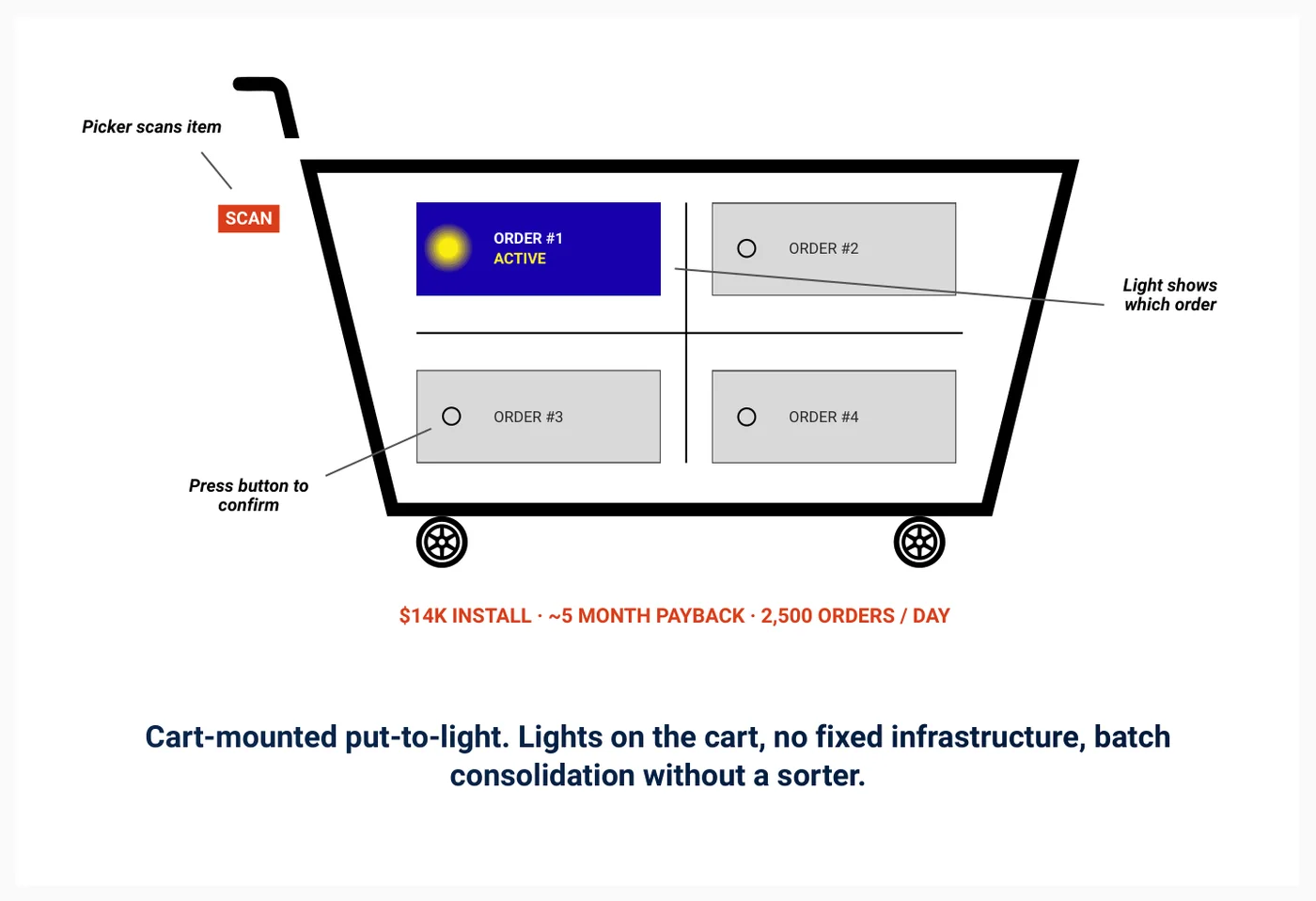
Put-to-light is the complement to batch picking. A picker batch-picks 15 or 20 orders’ worth of items into a single consolidation tote, then stands at a put wall with labeled cubbies, one per order. The system lights up the cubby where each item belongs. When a cubby’s light shows complete, the order is ready to pack. PTL is the highest-leverage semi-automation move for a 3PL going into heavy fulfillment. It converts a batch pick (highly productive per picker) into complete orders without a sorter. Cost is a fraction of full automation. Payback is fast. Flexibility is high.
A real put-to-light story, on a budget
The most useful pick-to-light story I can tell is actually a put-to-light story. The operation was running about 2,500 orders a day. A lot of operators hear light-directed picking and picture a quarter-million-dollar install. That is one version of it. The version this client did cost about $14,000. Four carts, lights mounted on the totes, no fixed infrastructure. Pickers scanned items off the shelf the normal way, then the cart told them which order each item belonged to. Press the light, drop it in, move on. The point is not the dollar figure. The point is that automation in fulfillment does not have to be all or nothing. Find the place where the manual process is hurting you most, and put the technology there. Leave the rest alone. Payback was about five months. Not because the technology was magic, but because we picked the right place to spend.
Which 30 feet of your floor is bleeding the most labor? That is the question. Usually nobody is asking it that way.
Pack Stations and Pack Lines
Pack is where small operations lose a surprising amount of money. Packers choosing the wrong box and paying dim-weight penalties. Inserts missed because they were not visible at pack time. Documents printing to the wrong station. By Stage 3 and beyond, pack stations should be system-directed. The tote arrives with an order. The scan pulls up the right box size. The label and documents print at the station. The packer’s only judgment call is quality.
The Technology Stack That Scales
Every capability below starts as optional at Stage 01 and becomes mandatory by Stage 04. The 3PLs that plan their technology path against the stages they expect to hit, rather than against their current volume, arrive at scale without a rebuild. The 3PLs that buy for today rebuild twice on the way to 10,000.
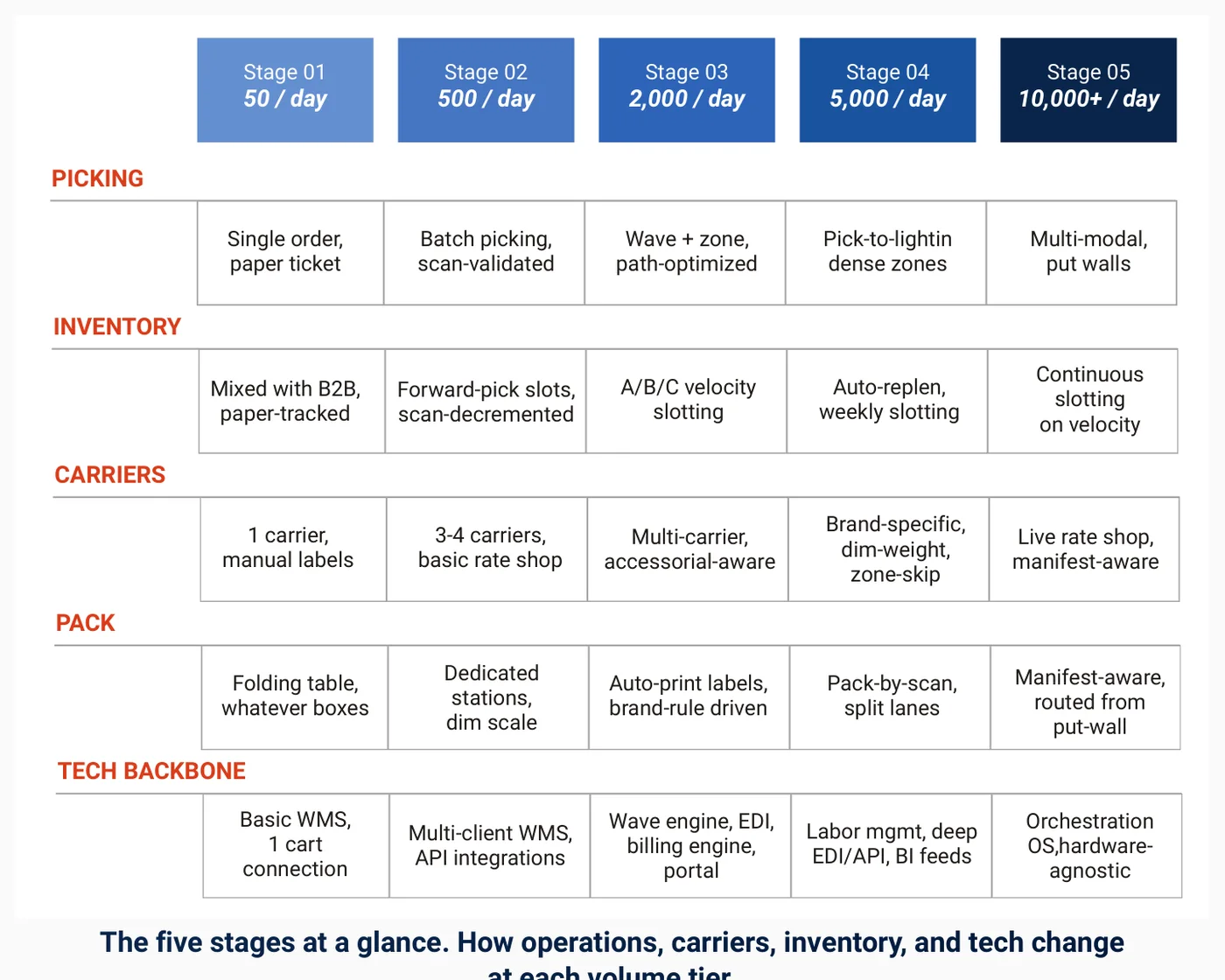
The matrix above is the field reference. Find your row, find your stage, see what is overdue. The notes below add only what the matrix cannot show.
What deserves a closer look
Order Management
A real OMS pulls orders from every channel into one queue, normalizes them, and applies business rules. Order hold for fraud checks. Consolidation for the same address. Splitting by carrier or inventory location. Backorder and pre-order handling. Without it, exceptions live in email.
Batch and Wave Picking
Batch picking groups multiple orders into one pick walk, assigning each order to a tote position or a put-wall slot. Wave picking groups batches into coordinated releases timed against carrier cutoffs, pack capacity, and labor. Done right, batch and wave together raise units per hour by two to three times versus single-order picking.
Pick Path Optimization
A good pick-path engine looks at the pick list, the warehouse map, the picker’s current position, and the downstream flow, and sequences picks to minimize total travel. It is more than nearest-next-item. It is routing that considers zones, put-wall slots, carton dimensions, and congestion. At 2,000 orders a day, the difference between naive routing and optimized routing is often two full-time equivalents of labor.
Pick-to-Tote with Scan Verification
Every pick scanned against expected SKU, quantity, and tote position. Errors caught at the shelf, not at the pack station. Inventory decremented in real time. This is the foundation of any real fulfillment operation.
Rate Shopping and Label Creation
Rate shopping decides, for every shipment, which carrier and service will deliver on time at the lowest real cost. Real cost means after accessorials, after dim-weight, against the 3PL’s or the client’s specific rate card, with surcharges current. A nightly rate update is not enough at Stage 4 and above. Once rate shopping has chosen, label creation prints the carrier label, any compliance labels, the packing slip per the brand’s template, and any inserts in the right order at the right station. If your packers are choosing which document to print, you have not yet automated this layer.
Integration architecture
This is where B2B 3PLs most often underinvest. In B2B, a few EDI trading partners is enough. In fulfillment, you will touch five to ten shopping carts, ten or more carriers, several marketplaces, and at least one BI or client portal. The right architecture is integration-first. A platform with pre-built connectors, an EDI library for retail compliance, and an open API so unusual cases get handled in days instead of months.
Integration breadth is what lets a 3PL onboard a new brand in a week instead of a quarter, and it is visible to prospects on the call.
Multi-Client and Multi-Brand Architecture
Each brand’s orders, inventory, reporting, rate cards, and branded documents have to be distinct. The operator sees one floor and one set of waves. Each brand sees only their own data. If this is bolted on rather than designed in, every new client becomes a configuration tax.
Real-Time Inventory
Inventory has to decrement at the scan, not at the end of the shift. Cycle counts run on exception and on schedule. The system has to support lots, serials, and expiry where relevant, because the moment you onboard a food, supplement, cosmetic, or regulated-goods brand, those become mandatory.
Labor Management and Standards
Engineered standards per task. Picks per hour by zone. Packs per hour by line. Real-time tracking against standard. Dashboards that show variance. This is how a Stage 4 or 5 operation stays profitable. Without it, the P&L tells you about a problem 30 days after it started.
Reporting and Client Portal
Brands at scale want visibility. A real client portal shows order status, inventory on hand and on order, SLA performance, returns, billing, and trends. Self-serve, real-time, branded. Brands that are not given transparency will ask for it constantly. Brands that are given it stay longer.
Billing & Pricing: The Hidden Discipline
Billing is the heart of the whole 3PL world, B2B or fulfillment. The difference is that in B2B, billing is simple. In fulfillment, billing is where you either keep your margin or quietly hand it back.
How B2B billing actually works
B2B has maybe four buckets. Receive a pallet, store it, ship it out, occasionally do something value-added like relabeling or de-stuffing a container. Storage might tier by duration. Pallet-out might flex depending on whether you ship as received or build a mixed pallet. Most operators have a rate card that fits on a page, and most clients are fine with that, because there is not enough variability to bill for.
How fulfillment billing actually works
Fulfillment is the opposite. Every shrug becomes a line item, and the operators who do not see that lose money on shrugs.
Every activity on the floor should map to a billable event. Every billable event should reconcile to contract.
The pen example
Here is the example I use to make this concrete. Say you are picking pens. A hundred orders, one pen each. The pens come ten to a case. Your WMS does batch picking. Pickers grab ten cases, walk them back to the pack station, and sort the pens into a hundred individual shipments. The work is the same as if they had picked each pen individually. Now look at the billing. If you priced this as a case pick at four dollars, you bill forty dollars for the wave. If you priced it as an each-pick at one dollar, you bill a hundred. Same work. Different revenue. The pricing decision determined whether you captured your revenue or gave away 60 percent of it. Batch picking is an operations decision. Billing for what actually got picked is a business decision. People conflate the two and bill for the operational shortcut instead of the work performed.
Everything else fulfillment quietly adds
Returns processing with quality checks. Branded inserts. Can you add this holiday flyer to every shipment? Sure. That flyer adds three or four seconds per order. It takes up space at the pack station. Someone has to keep enough of them stocked. None of that is free, and almost none of it gets billed. Run that math at a hundred orders a day across a month and the number is real.
The integration myth
The other thing 3PLs miss is integration cost. I talk to operators all the time who tell me we have to pay $50 a month for the Shopify integration on our WMS, it is eating our margin. Fifty dollars a month is not eating your margin. It is a pass-through. Charge the client for it. That is standard. The fact that you are absorbing it tells me you have not thought of integrations as billable, and if you have not thought of integrations as billable, what else are you absorbing?
The accessorial trap
Address corrections. Residential surcharges. Saturday delivery. Fuel adjustments. Peak surcharges. These show up on the carrier invoice every shipment, and most B2B-trained 3PLs let them sit on their own P&L instead of passing them through. Treat carrier accessorials as pass-through by default. The exceptions should be the small set you absorb intentionally as part of a competitive rate, not the entire list because the rate card never accounted for them.
The right approach
Design the rate card with the same care as the operation. Price every activity. Reconcile every shipment. Pass through what should be passed through. Build the billing engine into the WMS so invoices are generated from actual floor data rather than rebuilt in a spreadsheet at month-end.
A 3PL that bills accurately keeps its margin. A 3PL that bills approximately donates it.
Labor At Scale
Labor is the topic most operators underestimate when they come from a B2B base. The reality is that e-commerce sees swings B2B never does.
Holiday season hits and you need another 20 people for six weeks. They work with you for that stretch and you may never see them again. One client runs a nationwide sale and an operation processing 2,000 orders a day suddenly has to process 10,000 in a day, or 10,000 across two days. I have seen this happen often. It is normal in fulfillment. It barely happens in B2B.
That changes how you think about staffing. You need reliable temp staffing partners, because sometimes you need 50 workers next week and sometimes you need them tomorrow. You need cross-training that is not optional. The institutional knowledge of which packer knows which client should not exist. And you need processes simple enough that you can pull someone off the street, walk them to a station, and have them picking orders inside an hour.
That last part is where technology earns its keep on the labor side. If your pick process requires a week of training, your peak season will be a fire drill every year. If the system directs the picker, lights tell them where to put it, and the scan catches errors before they leave the station, training collapses to a couple of hours.
The technology is not replacing labor. It is making labor interchangeable, which is the only way you survive a 5x volume swing on two weeks of notice.
Returns Are An Operation, Not An Afterthought
Returns are 15 to 30 percent of fulfillment volume in many categories. At low volume you can muscle through. At higher volume, returns stop being an afterthought and start being an operation.
The reason is what returns actually involve. A unit comes back. Someone has to inspect it. Depending on the product and the condition, the inspection has steps. Visual check. Functional check. Repackaging if the original is damaged. Relabeling if the product was opened. Restocking if it passes. Disposition routing if it does not. At scale, this is reverse manufacturing more than warehouse work. You are rebuilding sellable units.
That is why some brands run returns in a different building than fulfillment. The flow is different, the labor profile is different, the SOPs are different. Trying to do both above a certain volume creates more problems than it solves. Not every 3PL needs a separate facility. But at higher volumes, treating returns as a corner of the fulfillment floor is the same mistake as treating fulfillment as a corner of the B2B floor.
Plan for it early. A returns process designed after the fact is expensive to build and ugly to run. Plan for returns at Stage 2, not Stage 4. The build is much cheaper before you have ten brands with ten different return policies than after.
Reading The Brand-Side Signals
Brands know they are outgrowing their 3PL before the 3PL knows. That is the part most operators miss.
The signs from the brand’s side are obvious to them. SLAs slipping. Support that used to be responsive going slower. They ask about running a sale and do not get the answer they need. They ask about an integration the 3PL does not have. They ask about EDI compliance for a retailer they just landed and the 3PL says we will figure it out. Each of those moments is a deposit in a jar marked find a new 3PL.
Here is the part that should keep operators up at night. I have worked on the brand side. Brands in the small-to-mid space, think e-commerce brands under $10 million in revenue, often do not tell their 3PL they are leaving. They cannot afford to. Their entire business depends on inventory sitting in that warehouse, and they do not want to spook the operator into deprioritizing them during the transition. So they shop quietly, line up a new partner, and move when they are ready.
The 3PL finds out the customer is leaving on the day the customer is leaving.
Bigger brands behave differently. Their contracts and volumes give them more leverage, and the transition itself is harder to hide. But under $10 million, the silent exit is normal.
If you are losing brands at this size, the question is not why didn’t they tell us. The question is what were we missing two months ago that they were already noticing. The answer is usually some combination of the things in this paper. Integrations they needed.
EDI capability that was not ready. An SLA conversation that did not go well. Brands are not quiet because they do not care. They are quiet because they are protecting themselves. That is a healthy instinct on their side, and an early-warning system you have to build on yours.
Picking & Switching A WMS
Changing your WMS is horrifying. There is no nice way to say it.
The first implementation probably took a year, and that is an understatement for some operators. I have seen companies that tried to build their own, spent a quarter million or half a million dollars on it, slowly came to realize they were turning into a technology company instead of a 3PL, and then had to switch anyway. After all that.
The mid-tier operators are the ones I feel for the most. You have spent two or three hundred thousand dollars on whatever you are running, plus a year or two getting it to a place where you can live with it. You do not love it. You live with it. And now someone is telling you to start over.
The cost of staying shows up on the floor every day. The cost of switching shows up once.
It is like being in a relationship for five years and realizing it is not working. You do not leave. You put in another year trying to make it work. Then another. At some point, if it is not going to work, it is not going to work, and the years you spend in denial are years you do not get back.
Most 3PLs I talk to have also been burned at least once. False promises in the sales cycle, features that were not really features, implementations that ran double the timeline. By the time someone is on their second WMS conversation they have stopped believing demos. Which is rational. But it also keeps them stuck on a system that is actively costing them clients.
The honest answer to when is it time to switch is this: you already know. The operators who ask me know the answer before they ask. What they want is permission, or a roadmap, or someone to tell them it will not be as bad as last time. I cannot always tell them it will not be as bad. Sometimes it is. What I can tell them is to pull the band-aid off and stop fighting it.
Everything else fulfillment quietly adds
Most 3PLs evaluate WMS for the stage they are in today. They are doing 200 orders a day, so they evaluate platforms against 200-orders-a-day requirements. Two years later they are at 2,000 orders a day and the system cannot carry them. So they switch. That is the story I keep hearing. The fix is to shop for where you are going. If your ambition is 10,000 orders a day across multiple facilities in three years, your evaluation criteria need to reflect that. There is a catch though. If you only shop for your future state, you will find platforms you cannot afford right now. So the real skill is balance. Find the system that handles where you are, can carry you to where you are going, and is itself on a growth path that matches yours. The WMS company that is stagnant today will not have built the features you need by the time you need them.
Most 3PLs evaluate a WMS like they are buying a tool. You should evaluate it like you are picking a partner for the next decade.
Common Pitfalls When Moving From B2B to Fulfillment
These are the mistakes I have seen most often in operations moving from a B2B base into fulfillment. Each one is preventable if recognized early.
01. Using the B2B WMS for Fulfillment "Temporarily"
Temporary becomes eighteen months. A B2B WMS generally lacks piece-level picking, batch and wave logic, rate shopping, and the integration breadth fulfillment requires. By the time the team admits it, you have thousands of orders configured, clients depending on reports, and a conversion project that takes a year. Make the platform decision before Stage 2, not after.
02. Mixing B2B and B2C Inventory in The Same Locations
In the short term, it saves space. In the medium term, it creates inventory drift, safety-stock confusion, and pick-error cascades. The moment fulfillment is a line of business, fulfillment inventory needs its own locations, its own replenishment triggers, and its own cycle-count schedule.
03. Treating Pack Station Complexity As Tribal Knowledge
Every packer knows which carrier gets which insert. Until they do not, or one of them quits. Packer decisions should be system-directed by Stage 03. Every insert rule, every carrier rule, every box-size rule should be captured in configuration, not in the packer's head.
04. Under-Investing in Integrations
Every custom connector is a future maintenance cost. Every missed API deprecation is a client outage. 3PLs that treat integration as a one-time cost find themselves with twenty fragile pipelines at Stage 04; 3PLs that treat it as a platform capability onboard brands in days.
05. Rate Shopping As An Afterthought
A consistent 10 to 20 percent savings per shipment is available through real rate shopping. Without it, margin disappears invisibly. With it, margin becomes a competitive advantage that is hard to see from the outside and hard to replicate without the technology.
06. Ignoring Returns Until They Become a Problem
Returns are 15 to 30 percent of fulfillment volume in many categories. A returns process designed after the fact is expensive to build and ugly to run. Plan for returns at Stage 2, not at Stage 4.
07. Hiring Fulfillment Leaders Into a B2B-Shaped Organization
A dedicated fulfillment leader is essential from Stage 02 onward. Trying to run B2C out of B2B operations leadership, with B2B-trained supervisors, and B2B-trained labor, produces a B2B-shaped fulfillment operation, which is not a fulfillment operation.
08. Underestimating How Long The Transition Will Take
This one is on me, from earlier in my career. I was leading a transition at a half-million square foot facility with about 50 clients on the floor. We planned it carefully. Two to three weeks of prep, then a transition window of about three and a half months. The plan was solid. I was confident. Three months in, the warehouse manager quit. A few weeks later, a third key employee left. Both of them, I think, did not want to live through the transition. Some people do not. Change is exciting if you are leading it. It is exhausting if you are being asked to do your normal job while everything around you is being rebuilt. That is when I learned how dependent the whole project was on people I had not planned to lose. We did not have cross-trained backups. The institutional knowledge walked out with them. The project went on hold while we hired and rebuilt. What was supposed to be three and a half months became roughly eleven. The lesson was not really about project planning. It was about buy-in. Management can pull a transition through on willpower for a while, but if the people doing the actual work have not bought into the vision, you are one resignation away from a stalled project. Get buy-in from every level. Cross-train before you think you need to. Assume that at least one key person will leave during the transition, because in a long enough project, one of them usually does.
Readiness Checklist
A short self-assessment. Read the list for the stage you are about to move into not the stage you are in today.
Moving Into Stage 02 (500 Orders/Day)
- Dedicated pick area separated from B2B.
- Batch-picking logic in the WMS, with scan verification.
- Pick-to-tote discipline: every pick is scanned, every tote is traceable.
- Rate shopping across at least three carriers.
- Multi-client architecture with separate orders, inventory, and reporting per brand.
- Flow rack or carton flow installed for top movers.
- A real returns workflow, even if small.
Moving Into Stage 03 (2,000 Orders/Day)
- Wave planning tied to carrier cutoffs.
- Pick-path optimization, not just "nearest next location."
- Zone picking introduced where density supports it.
- Split pack lines by order class.
- API-first or EDI-templated integration: no more bespoke connectors.
- EDI flows for at least one retail-facing client.
- A billing engine that reconciles to contract per brand.
- Client portal with SLA visibility.
Moving Into Stage 04 (5,000 Orders/Day)
- Continuous wave release with labor awareness.
- Pick-to-tote with downstream routing to the correct pack lane.
- Pack-by-scan with system-directed box and document selection.
- Weekly slotting review driven by velocity data.
- Labor management with engineered standards tracked in real time.
- Pick-to-light in the densest zones, put-to-light for batch consolidation.
- Rate shopping with accessorials, dim-weight, and account-level rates.
- Deep API and EDI breadth: five or more carts, ten or more carriers.
Moving Into Stage 5 (10,000+ orders / day)
- Multi-tenant, fulfillment-native WMS.
- Real-time wave orchestration balancing inventory, labor, cutoffs, and SLAs.
- Put-walls or sortation for multi-line orders.
- Predictive labor planning tied to inbound forecasts.
- Full BI suite: cost per order, cost per pick, UPH by zone, perfect order rate.
- Open API for hours-not-weeks brand onboarding.
- Retail-compliance EDI library pre-built.
- Live rate shopping, not nightly.
- Hardware-agnostic integrations to MHE, conveyor, sortation, scale-in-motion.
Closing Thoughts
The 3PLs that move well from a B2B base into fulfillment will own the next decade of third-party logistics. They have the buildings, the client relationships, the labor network, and the operational discipline.
What they have to build is the fulfillment-shaped version of themselves.
That build is a transformation, not a project. Process, people, physical setup, and technology have to move together.
A new WMS without a new floor plan fails. A new floor plan without a new labor model fails. New labor standards without new technology fail. The stages in this paper are a way of thinking about which piece has to move when.
Stop treating fulfillment as a new service. Start treating it as a new company inside your company.
Give it its own leadership, its own floor, its own processes, and its own technology. The economics reward that discipline, and the clients reward it more. I am always glad to compare notes with operators making this move. On any part of the journey.
Where This Series Goes Next
This paper is the first in a series of operator-focused field guides for 3PLs scaling into fulfillment. Each future paper goes deeper on a topic introduced here. They are written to stand alone, and to function together as a complete operational reference.
Pricing What Actually Got Picked
The fulfillment billing and pricing playbook. Activity-based rate cards, accessorial pass-through, the pen example expanded across SKU classes, contract reconciliation against floor data, and the pricing mistakes that cost 3PLs the most margin.
The Integration Moat
API and EDI architecture as a competitive advantage. How leading 3PLs onboard brands in a week, what the right integration stack looks like at each volume stage, and why integration breadth beats integration depth for most operators.
Labor That Survives a 5x Swing
Cross-training, temp-staffing partnerships, peak-season planning, and the operational design choices that make labor interchangeable. How to build a workforce that can scale in days, not weeks.
Why the WMS Always Goes First
Picking, switching, and surviving a WMS transition. Vendor evaluation criteria, implementation pitfalls, the emotional math of leaving a system you have invested in, and the playbook for changing platforms without losing clients.
Returns Are Reverse Manufacturing
Designing a returns operation at scale. SOP libraries, brand-specific disposition rules, when to run returns in a separate building, and the technology that makes high-volume returns profitable.
Reading the Brand-Side Signals
How to detect a quiet exit before it happens. Early warning indicators, the conversations brands are having that you are not in, and the account-management practices that keep small-to-mid brands from leaving silently.
The Fulfillment-Native 3PL
Synthesis. What the 3PL of the next decade looks like, how to build toward it from a B2B base, and the leadership shifts that make the operational shifts possible.
If you would like to be notified as future papers are released, follow vikrantneb.com or connect on LinkedIn.
About the Author
Vikrant Neb is an industrial engineer who has spent his career around operations. He has run e-commerce companies, led manufacturing operations through Kurieta during his consulting years, and worked with 3PLs across the full range of volumes and transitions covered in this paper.
He is the founder of Leanafy, a warehouse management system built specifically for 3PL operators, and Kurieta Operations Consulting. His book, Execution Under Pressure: The Hidden Reasons Why 3PLs Stop Growing and How to Fix Them, came out in 2026. He hosts the Execution at Scale podcast and splits his time between Indianapolis and Vancouver.
This paper covers one slice of his work, the move from B2B into fulfillment. He is always glad to compare notes with operators making this move, and on the other things that come up around it.
vikrantneb.com · linkedin.com/in/vikrant-neb