The Hidden Cost of Getting Pricing Wrong
A 3PL’s Guide to Margin That Disappears Before You Notice
How unnoticed scope creep, changing customer behavior and operational complexity quietly eat away at your margins, even when business appears healthy.

About this paper
Every missed scan, manual process, and unbilled service chips away at your profits. Learn where margins are lost and how leading 3PLs protect them.
You can be busy and unprofitable at the same time. That is the part most operators do not believe until it happens to them.
Why This Paper.
“You can be busy and unprofitable at the same time. That is the part most operators do not believe until it happens to them.”
In the last paper I wrote about the operational transformation from B2B to fulfillment, five stages from fifty orders a day to ten thousand. This paper goes into the layer underneath all five stages: what you actually charge for, and why the gap between what you charge and what it costs quietly widens the whole time you think business is good.
Pricing in a 3PL is not one decision made once. It is a hundred small decisions made every day, most of them invisible, most of them made by someone other than the person who set the rate card.
I wrote this paper for the operator who has looked at a healthy P&L and still felt like something was off. The reader I have in mind knows their revenue. They are less sure they know their cost.
The Averages Problem
Here is a pattern I have seen more times than I can count. A 3PL has twenty customers. Sixteen of them are genuinely profitable. Four of them are quietly losing money.
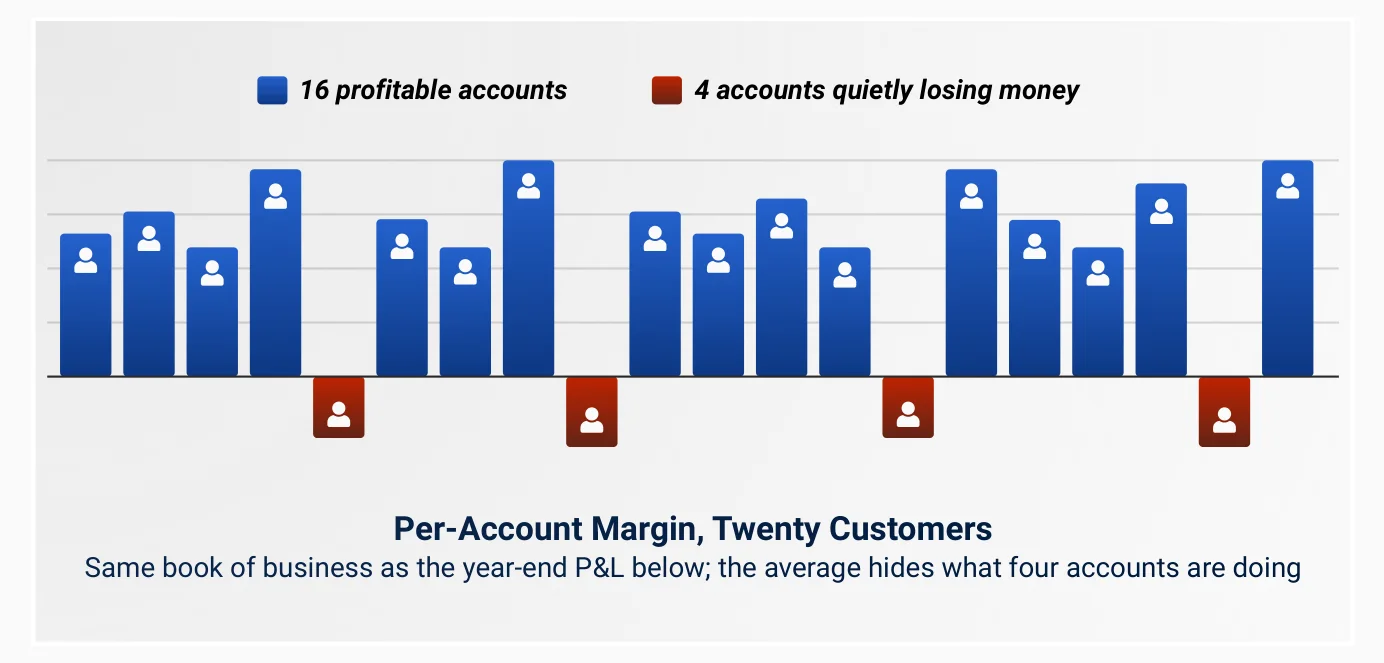
Nobody notices, because the P&L only shows the average. Leadership looks at the year-end number and says we made a million dollars, we had a good year. What that number does not show is that four accounts are eating margin that the other sixteen are generating, and if those four were repriced or let go, the business could make significantly more money without adding a single new customer.
This does not look like failure. It looks like success that could have been slightly better. And because the average looks fine, nobody feels urgency to dig into any one account.
The unprofitable accounts are rarely the obvious troublemakers. They are not late payers. They are not difficult people. Often they are long-standing relationships, comfortable ones, with consistent volume and a customer who is pleasant to deal with. Everything about the relationship feels right except the economics, and the economics are invisible because nobody has ever isolated what it actually costs to serve that one account.
Revenue is not profitability. A customer generating two hundred thousand dollars a year that costs two hundred and twenty thousand to serve is not one of your biggest accounts. It is a subsidy, funded by the other sixteen. And every hour spent managing that account is an hour not spent on the accounts actually carrying the business.
Cost and Price Are Cousins
I had this conversation on the podcast with Bob Byrnes, who has spent over fifteen years building pricing structures at Kenco, Ryder, and Stord, and now teaches the Economics of Warehousing course at IWLA. He put something to me that has stuck with me since:
Cost and price are cousins. They are not married.
It sounds like a small distinction, but it changes how you think about a rate card. The instinct is to build price out of cost. Take what it costs to deliver a service, add the margin you want, and that becomes your number. Bob’s point is that the market does not care what your cost is. Price is what a customer is willing to pay. Cost is the separate number that determines whether that price is any good to you.
Those two numbers can drift apart in either direction, and most operators only notice when they have drifted apart in the wrong one.
There is a second layer to this Bob named directly: customers over-consume whatever they believe you have underpriced. If a customer believes your storage is cheap, they will store more with you than they need to. If they believe your handling is cheap, they will hand you every special project that comes up. The price you set does not just determine your margin on paper. It shapes how the customer behaves, and that behavior either protects your margin or quietly erodes it.
Scope Creep Nobody Notices
The most common reason 3PLs do not know their real cost to serve a customer is not a lack of intelligence. It is a lack of a mechanism. Nobody built a process to catch the moment a customer’s actual usage drifted away from what was priced.
Bob calls this attribute drift. You price a contract based on a set of assumptions: this volume, this SKU mix, this level of complexity. A year passes. The customer’s business has changed, sometimes without them realizing it themselves, and what you are actually doing for them looks nothing like what you priced. Nobody revisited the contract, because nobody was looking for the drift. It is not usually dishonesty. It is usually growth on the customer’s side that quietly became cost on yours.
The pen example, expanded
I have used this example before to make batch picking concrete: a hundred orders, one pen each, pens ten to a case. Pickers grab ten cases, walk them back, sort a hundred pens into a hundred shipments. The work is identical to picking each pen individually. Price it as a case pick at four dollars, you bill forty dollars for the wave. Price it as an each-pick at one dollar, you bill a hundred. Same labor. Different revenue, depending entirely on how the rate card was built.
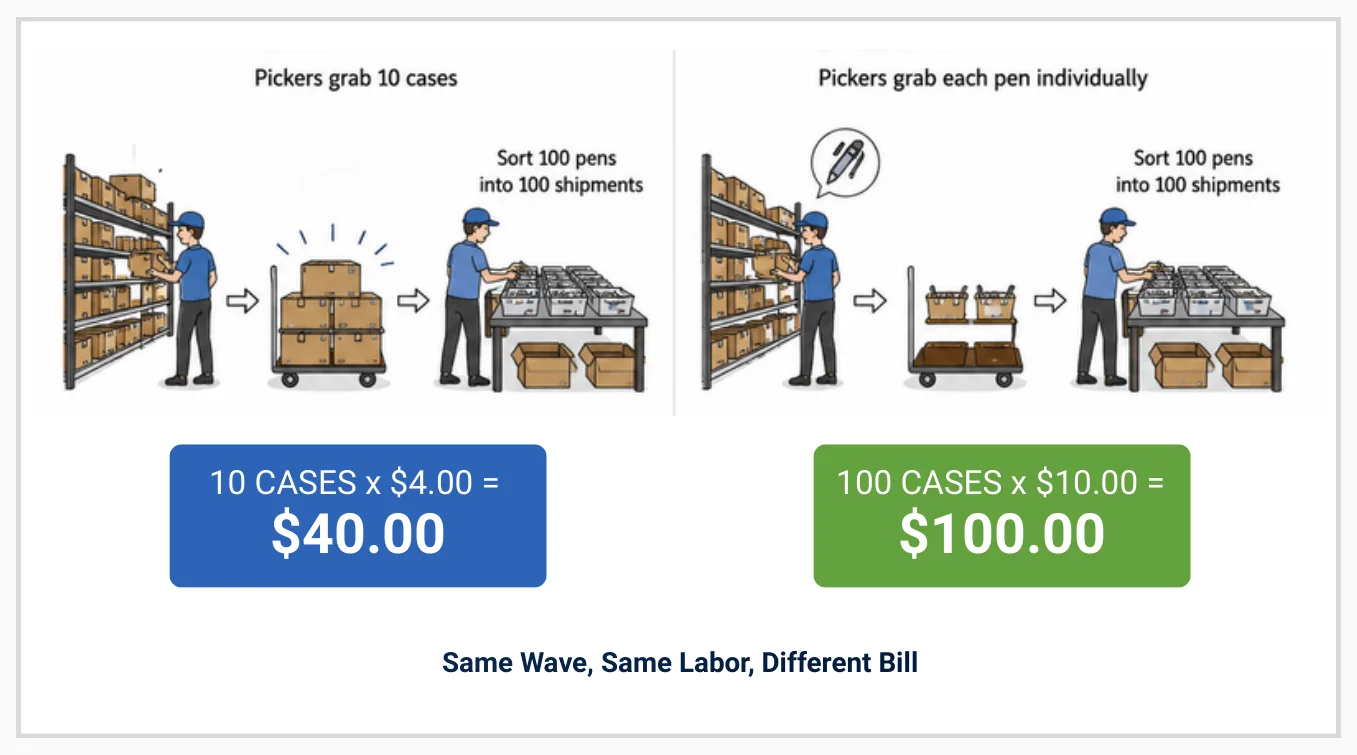
The drift shows up when you expand this across SKU classes rather than one product. Say the same client also ships apparel, some of it single-unit, some of it multi-pack.
The pickand-pack complexity is different for every class, but many rate cards apply one blended per-pick rate across all of them because that is what was quoted at onboarding. The eachpick rate that was fair for the pen becomes a giveaway on the apparel multi-pack, and a loss on anything requiring special handling. Nobody repriced it, because nobody built the mechanism to notice that the SKU mix, not just the volume, had changed.
What Is Acceptable At This Stage
One client I worked with sold LED lighting. Their instinct, a reasonable one on paper, was to slot inventory by product family: all the tube variants together, all the bulb variants together, grouped the way a catalog groups them.
The problem is that nobody orders that way. A customer buying a specific tube wattage does not also want three adjacent wattages in the same order, the same way nobody orders a brown shoe and a black shoe together just because they sit on the same shelf. The physical slotting was optimized for how the product looked in a catalog, not for how orders actually arrived. Pickers walked further than the layout implied they should, because the SKU density that looked efficient by product family was not the density that mattered, which was order density.
None of that showed up in the original pricing. The pick time assumed a layout logic that made sense to a merchandiser and none to an order profile. The fix was not a pricing conversation at all. It was a re-slotting exercise, moving inventory to reflect actual co-order patterns rather than catalog logic. But the business had been quietly absorbing that cost for months before anyone connected the dots between how the floor was laid out and why picks were taking longer than the rate card assumed.
The Expansion Trap
Bob gave me a second example that deserves its own section, because it is less about individual accounts and more about a decision leadership makes without realizing it is a pricing decision.
Picture a hundred-thousand-square-foot building running at ninety percent capacity. A prospect comes along needing twenty thousand feet. You only have room for ten thousand. The instinct is to say yes and go find a second building.
Here is the math nobody runs before signing. If the second building is roughly the same size as the first, winning this one customer means you now operate one building near full and a second building running at ten percent utilization. Rent on that second building does not scale down because only one customer is in it. The revenue from that one account is not going to cover the fixed cost of an entire additional facility, not for a long time, possibly not ever if growth stalls.
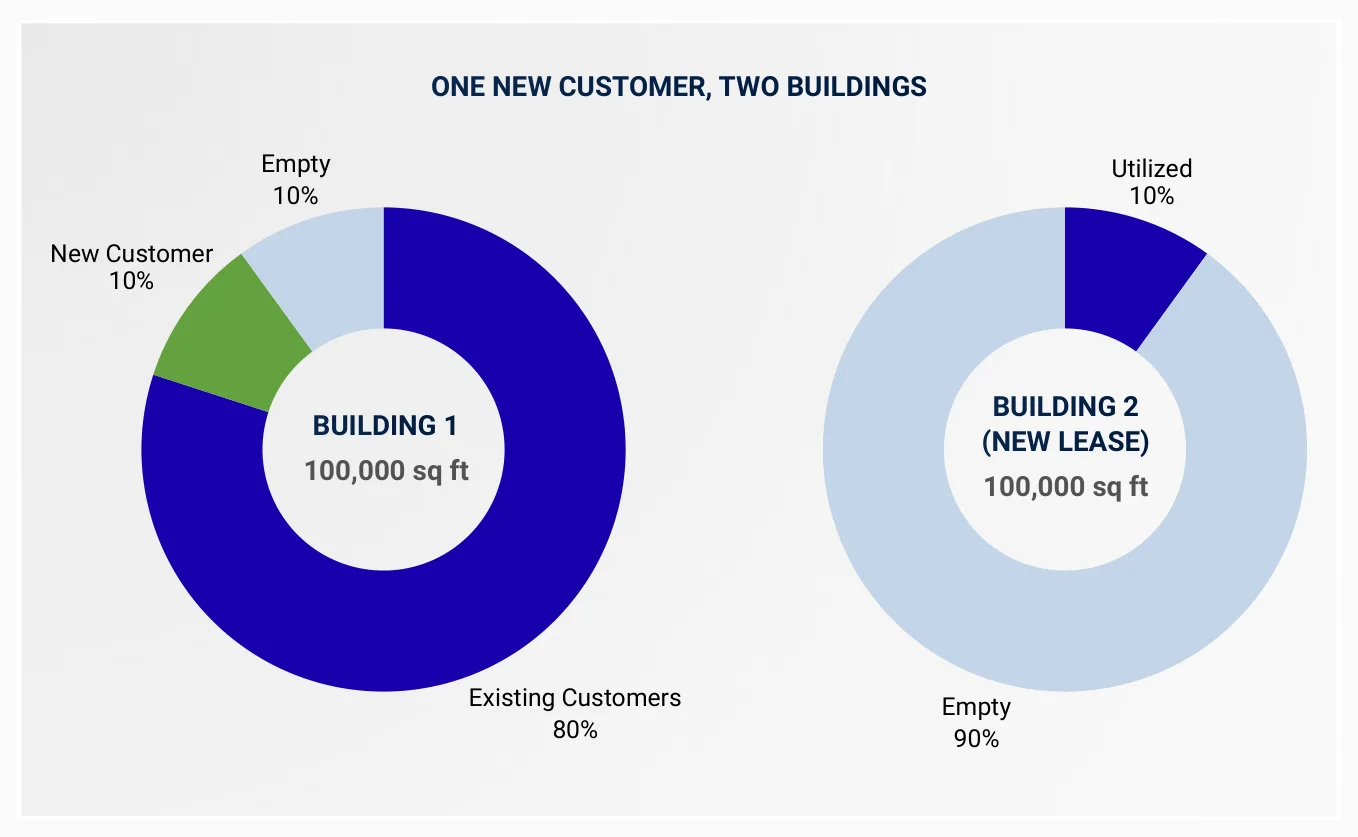
This is not a mistake in operations. It is a mistake in the pricing conversation nobody had. The real question was never can we win this account. It was: is revenue our goal here, or is margin our goal here. If margin, the better move might be a smaller footprint, a subleased corner of the new space, or simply declining the account until the timing is better.
If revenue and growth are genuinely the priority, that is a legitimate answer too, but it should be a conscious one, not something the business discovers eighteen months later when the second building still is not profitable.
Pricing is a management decision shaped by what the market will pay. It is also a management decision shaped by what the company is actually trying to do. Confusing growth with health is how expansion quietly becomes the thing that breaks the margin the original business was generating.
Billing Discipline, Revisited
The first paper in this series covered the mechanics of fulfillment billing: treating every activity as a billable event, passing through accessorials and integration costs instead of absorbing them, reconciling every shipment against contract. That discipline does not change here. What changes is the lens.
Averages hide the four unprofitable accounts. Attribute drift hides the SKU mix that outgrew the rate card. The expansion trap hides the fixed cost that a new account cannot actually cover. All three are the same failure wearing different clothes: a business that priced for one set of assumptions and never built the mechanism to check, months or years later, whether those assumptions still held.
A billing engine built into the WMS, generating invoices from actual floor data rather than a spreadsheet at month-end, is the tool that catches this. But the tool only works if someone is also asking the harder question behind it: not just did we bill correctly for what we did, but is what we are doing still the thing we priced.
What To Do This Week
Bob’s closing advice on the podcast was not a five-step framework. It was simpler than that, and worth repeating close to verbatim: most 3PLs do not win business on price alone. Price has to be right, but there has to be another reason a customer picks you. Find what that is, and build the process that makes you genuinely the best or the most efficient at it, at a margin that holds even if the price never moves.
Most 3PLs do not win business on price alone. Price has to be right, but there has to be another reason a customer picks you.
That is a good long-term answer. Here is a shorter one for this week specifically.
A five-point pricing gut check
Pull your customer list and rank accounts by revenue. Now estimate, even roughly, what each one actually costs to serve. If you cannot do this at all, that is the finding.
For your ten largest accounts, ask when the contract was last compared against what you are actually doing today, not what was quoted at onboarding.
Look at your rate card and identify anywhere a single blended rate covers activities with meaningfully different labor profiles. That is where the pen-and-apparel drift lives.
If you are considering an expansion, run the utilization math before the sales conversation, not after the lease is signed.
Ask which costs on your P&L are labeled fixed that are actually being covered by someone’s unpaid extra hours. That labor is not free just because it is not on an invoice.
None of these fix the whole problem in a week. What they do is tell you, honestly, whether you are the operator who knows their real cost or the one who is about to find out the hard way.
Closing Thoughts
Fulfillment rewards operators who price with discipline and punishes the ones who price once and never look again. The margin that disappears rarely disappears all at once. It thins one unexamined account, one drifted contract, one well-intentioned expansion at a time, until a P&L that looked healthy for years quietly is not.
Cost and price are cousins. Keep checking that they are still speaking to each other.
I am always glad to compare notes with operators working through this. On any part of the pricing conversation.
Where This Series Goes Next
This is the second paper in a series of operator-focused field guides for 3PLs scaling into fulfillment.
The Integration Moat
API and EDI architecture as a competitive advantage. How leading 3PLs onboard brands in a week, what the right integration stack looks like at each volume stage, and why integration breadth beats integration depth for most operators.
Labor That Survives a 5x Swing
Cross-training, temp-staffing partnerships, peak-season planning, and the operational design choices that make labor interchangeable. How to build a workforce that can scale in days, not weeks.
Why the WMS Always Goes First
Picking, switching, and surviving a WMS transition. Vendor evaluation criteria, implementation pitfalls, the emotional math of leaving a system you have invested in, and the playbook for changing platforms without losing clients.
Returns Are Reverse Manufacturing
Designing a returns operation at scale. SOP libraries, brand-specific disposition rules, when to run returns in a separate building, and the technology that makes high-volume returns profitable.
Reading the Brand-Side Signals
How to detect a quiet exit before it happens. Early warning indicators, the conversations brands are having that you are not in, and the account-management practices that keep small-to-mid brands from leaving silently.
The Fulfillment-Native 3PL
Synthesis. What the 3PL of the next decade looks like, how to build toward it from a B2B base, and the leadership shifts that make the operational shifts possible.
If you would like to be notified as future papers are released, follow vikrantneb.com or connect on LinkedIn.
About the Author
Vikrant Neb is an industrial engineer who has spent his career around operations. He has run e-commerce companies, led manufacturing operations through Kurieta during his consulting years, and worked with 3PLs across the full range of volumes and transitions covered in this paper.
He is the founder of Leanafy, a warehouse management system built specifically for 3PL operators, and Kurieta Operations Consulting. His book, Execution Under Pressure: The Hidden Reasons Why 3PLs Stop Growing and How to Fix Them, came out in 2026. He hosts the Execution at Scale podcast and splits his time between Indianapolis and Vancouver.
This paper covers one slice of his work, the move from B2B into fulfillment. He is always glad to compare notes with operators making this move, and on the other things that come up around it.
vikrantneb.com · linkedin.com/in/vikrant-neb